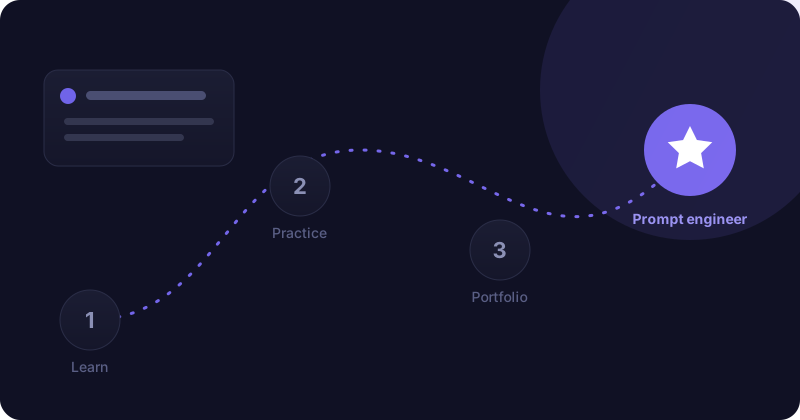
"Prompt engineer" went from a joke to a job title in about a year. Behind the hype there's a real skill: reliably getting useful, correct output from AI models, and doing it in a way other people can reuse. This guide lays out a practical roadmap. No certificate required, just deliberate practice and work you can show.
What a prompt engineer actually does
It isn't typing clever one-liners. The day-to-day is closer to engineering than to wordsmithing:
- Turn a vague goal into a precise instruction the model can act on, with the right context and constraints.
- Make outputs reliable, so the same prompt gives good results across inputs, not just once.
- Design for reuse, with variables, templates, and clear names, so a prompt becomes a tool a whole team can use.
- Evaluate and iterate, comparing versions and keeping the one that actually performs.
- Fit prompts into real workflows, often via an API, a CLI, or an AI IDE, not just a chat box.
The skills that matter
You don't need a CS degree. You do need a mix of these:
- Clear writing and decomposition. The core skill is breaking a fuzzy task into explicit steps and stating them unambiguously.
- Model intuition. Understanding what models are good and bad at, how context windows work, and why the same prompt behaves differently across models.
- Structure. Using roles, examples (few-shot), output formats, and constraints to shape responses.
- Evaluation. Defining what "good" means for a task and testing prompts against it instead of eyeballing one result.
- A little tooling. Enough comfort with an API, a terminal, or an AI IDE to run prompts where the work actually happens.
A step-by-step roadmap
1. Learn the fundamentals by doing
Pick one model and one real task you care about (summarizing research, drafting outreach, writing code). Write a first prompt, then improve it five times. Each round, change one thing and note what happened. You'll learn more in a week of this than from any amount of passive reading.
2. Practice the patterns
Deliberately practice the building blocks: assigning a role, giving few-shot examples, requesting a specific output format, adding constraints, and asking the model to reason step by step. For code specifically, our guide to AI coding prompts walks through the context, constraints, and task shape that produce usable code.
3. Build a prompt library
As soon as a prompt works, save it, name it, and parameterize it with variables. This is how one-off wins become reusable assets. If you've never set one up, start with what a prompt library is and how to build one, then keep version history so you can iterate without losing what worked.
4. Build a portfolio in public
This is the step most people skip, and it's the one that gets you hired or followed. Publish your best prompts publicly so anyone can see your thinking, not just the final text. A public profile that collects your prompts, with clear descriptions and version history, is a portfolio you can link to. For how to do that well, see where to share your AI prompts.
5. Work where the models work
Move beyond the chat box. Pull, push, and run your prompts from your own tools through a CLI and MCP server so your library is part of your real workflow. Being fluent here is what separates someone who writes prompts from someone who ships with them.
How to stand out
The market is noisy, so proof beats claims:
- Show results, not adjectives. A before-and-after, a sample output, or a prompt others actually reuse says more than "expert."
- Specialize. "Prompts for technical documentation" or "prompts for financial analysis" is more hireable than "AI generalist."
- Keep shipping. A library that visibly grows signals that you're serious and current.
Where to start today
Open the public prompt library, find prompts in your area, and study how the good ones are written: the role, the constraints, the variables. Then write your own, publish two or three, and start a profile. Becoming a prompt engineer isn't a credential you earn once; it's a body of work you build in the open, one improved prompt at a time.